
How an invention advances prostate cancer diagnostics
Radiohybrid PSMA ligands from Munich: from a lab idea through patenting and licensing to the approved diagnostic POSLUMA®.
From research into the clinic
Prostate cancer is the most common cancer in men. Choosing the right therapy depends on locating tumors as precisely as possible. It is equally important, if the disease returns after treatment, to quickly and reliably identify where it is active again. Radiohybrid PSMA ligands (rh-PSMA) were developed exactly at this interface of medical need and scientific innovation.
The starting idea: more precise diagnostics, more flexible use
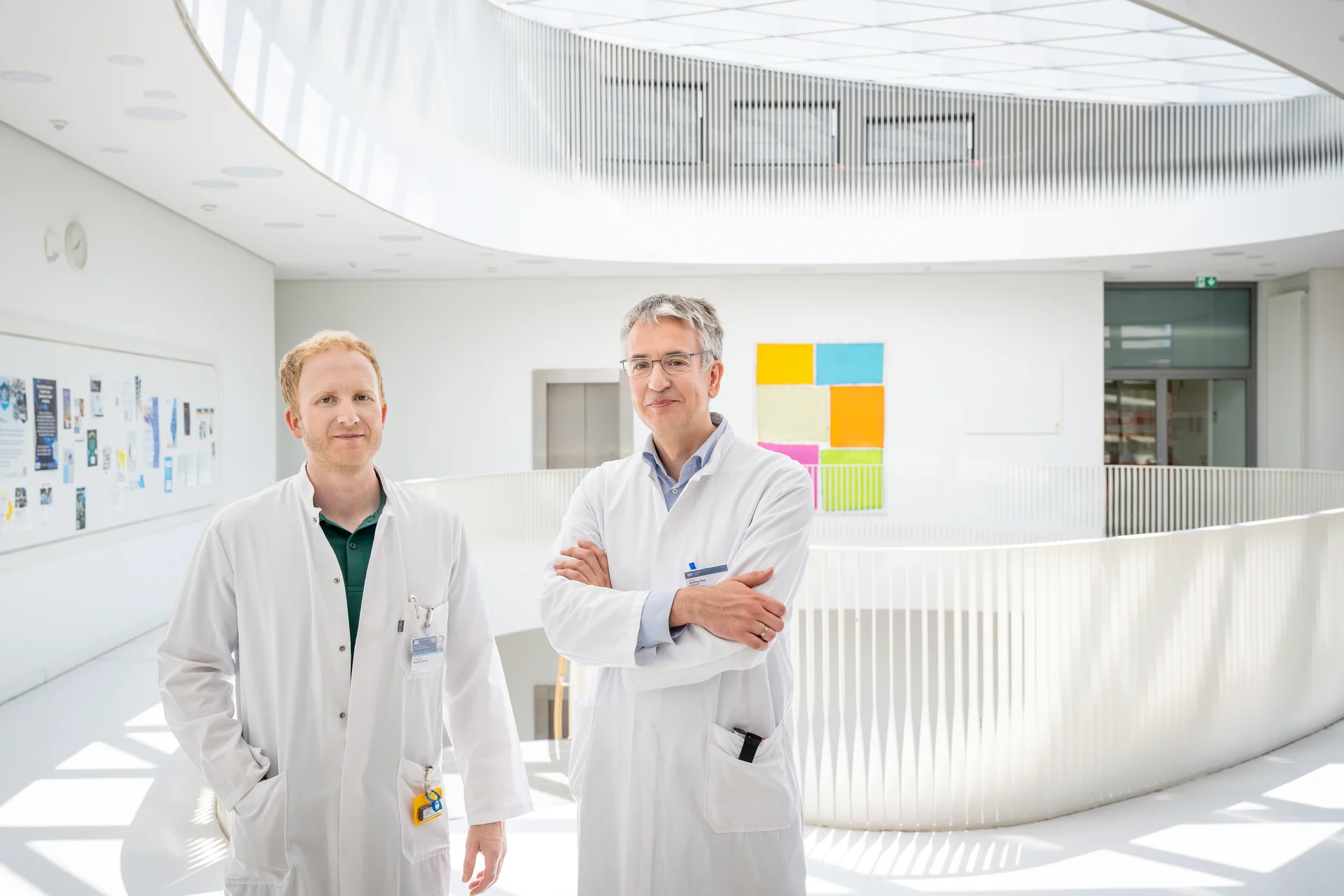
Prof. Dr. Hans-Jürgen Wester and his then doctoral researcher Dr. Alexander Wurzer developed a new class of molecular probes at TUM. They bind selectively to prostate-specific membrane antigen (PSMA), which is present at particularly high levels on many prostate cancer cells. These radiohybrid ligands enable highly precise imaging.
Together with Prof. Matthias Eiber of TUM University Hospital, development was advanced consistently toward clinical use. Especially relevant: the compound can be labeled with either gallium-68 or fluorine-18, making it flexible across different clinical settings.
“Our vision was to create a tool that every nuclear medicine physician can use universally, while also paving the way for targeted therapy.”
Prof. Dr. Hans-Jürgen Wester, TUM
What is PSMA?
PSMA (prostate-specific membrane antigen) is a protein found at high concentration on the surface of prostate cancer cells. Molecules that bind selectively to PSMA can be labeled with radioactive markers and thereby make tumors and metastases visible.
From invention to product
A scientific invention alone is not yet an accessible product. The path from lab idea to clinical use is long: the invention must be evaluated, patented, licensed, clinically tested, approved, manufactured, and marketed. Each phase requires specific expertise and the right partners.
The transfer pathway in 5 steps
- Invention at TUM and TUM University Hospital
- Evaluation and patenting with BAYPAT
- Licensing to Scintomics by BAYPAT
- Sublicensing to BED by Scintomics
- Further development by BED
- Approval as POSLUMA® (USA) advanced by BED
BAYPAT supports the transfer
With BAYPAT’s support, the technology was filed for patent protection and positioned strategically. BAYPAT quickly identified suitable industry partners, structured the licensing, and accompanied collaboration between science and industry throughout the transfer process.
“POSLUMA® impressively shows what becomes possible when excellent research is protected early and connected with the right industry partners. That is exactly the kind of transfer pathway BAYPAT stands for.”
Dr. Sarah Krüger, Head of IP Licensing: BAYPAT Licensing Team
The technology was licensed to Scintomics GmbH. Scintomics GmbH played a central role in moving the academic invention into an industrially developable technology, bridging university research and clinical application. Another key milestone was a sublicense agreement with Blue Earth Diagnostics Ltd. (BED), which advanced further clinical development and commercialization.
“Licensing through BAYPAT gave us the foundation to advance development of the rh-PSMA technology consistently and at scale.”
Jan Niclas Wester, CEO: Scintomics GmbH
POSLUMA®: why the technology stands out
Today the diagnostic is approved in the United States under the trade name POSLUMA®. POSLUMA® enables targeted imaging of PSMA-positive lesions in people with prostate cancer and can support, in particular:
- making the location and extent of disease more clearly visible
- localizing a possible recurrence after prior therapy
- better supporting medical decisions and more individualized treatment planning
“For our patients it is essential that we assess tumor extent as accurately as possible. When we first saw images created with this new compound, we were impressed by the clarity and precision with which even the smallest tumor foci became visible.”
Prof. Matthias Eiber, Head of the Section for Theranostics, TUM University Hospital
“What also sets the diagnostic apart is its robust and efficient manufacturing. Simple synthesis and high scalability make it possible to produce the compound reliably at large volume.”
Dr. Alexander Wurzer, RadioPharmTUM, Department of Nuclear Medicine, TUM University Hospital
Note: Radiohybrid technology has long-term potential for theranostic applications. Therapeutic applications of this invention are not yet approved.
Conclusion
POSLUMA® is visible proof that the path from research to patients is not chance, but the result of strategic technology transfer. BAYPAT accompanies inventions from Bavaria on exactly this path. For researchers, companies, and Bavaria as a science location, early contact with BAYPAT pays off.

What this means for you
POSLUMA® shows how Bavarian research can become an approved diagnostic for more precise localization of prostate cancer.
That is made possible by professionally guided technology transfer with substantial impact for researchers, entrepreneurs, universities, and the public.
For researchers
A strong scientific idea can become an application with international impact through IP protection, clinical validation, and professional partnering. Disclose your invention early.
For companies
POSLUMA® illustrates the kinds of technologies waiting in the BAYPAT portfolio: scientifically grounded, with concrete development and market potential. Explore licensing opportunities.
For universities and transfer partners
Successful commercialization creates impact and strengthens your institution’s reputation. BAYPAT also supports complex and international commercialization processes.
For policymakers and the public
Publicly funded research at Bavarian universities can lead to innovations that help patients and bring value creation back to the region.