

Challenge and innovation
Conventional cryptography relies on computational hardness and key management at higher layers, but its complexity clashes with strict cost and energy limits in IoT devices. Physical Layer Security (PLS) instead exploits channel noise and coding, using the same physical-layer resources for both error correction and secrecy. Conventional polar-code PLS wiretap schemes offer information-theoretic security only if Eve's channel is degraded versus Bob's—a highly restrictive requirement that limits their practical applicability.
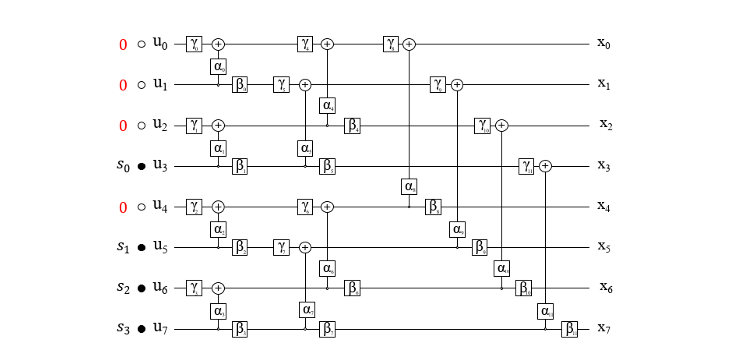
The scheme realizes PLS via a user‑specific symbol‑level configuration known to the transmitter Alice and intended receiver Bob but unkown to the adversary Eve. While binary polar codes offer only a small, performance‑constrained configuration space, non‑binary polar codes with non‑Kronecker constructions and finite bi-right-quasigroup (FBRQ)‑based arithmetic vastly enlarges this space. With a matched configuration and SCL decoding, Bob recovers the message, while Eve sees near‑random outputs. The vast configuration space thwarts brute‑force attacks, exceeding 256‑bit high-security threshold even for short block lengths.

Talk to an expert
Interested in learning more about this technology offer, exploring potential applications or discussing a possible collaboration? Get in touch to learn more.