
New linker for affinity resins boosts binding capacity

Challenge and innovation
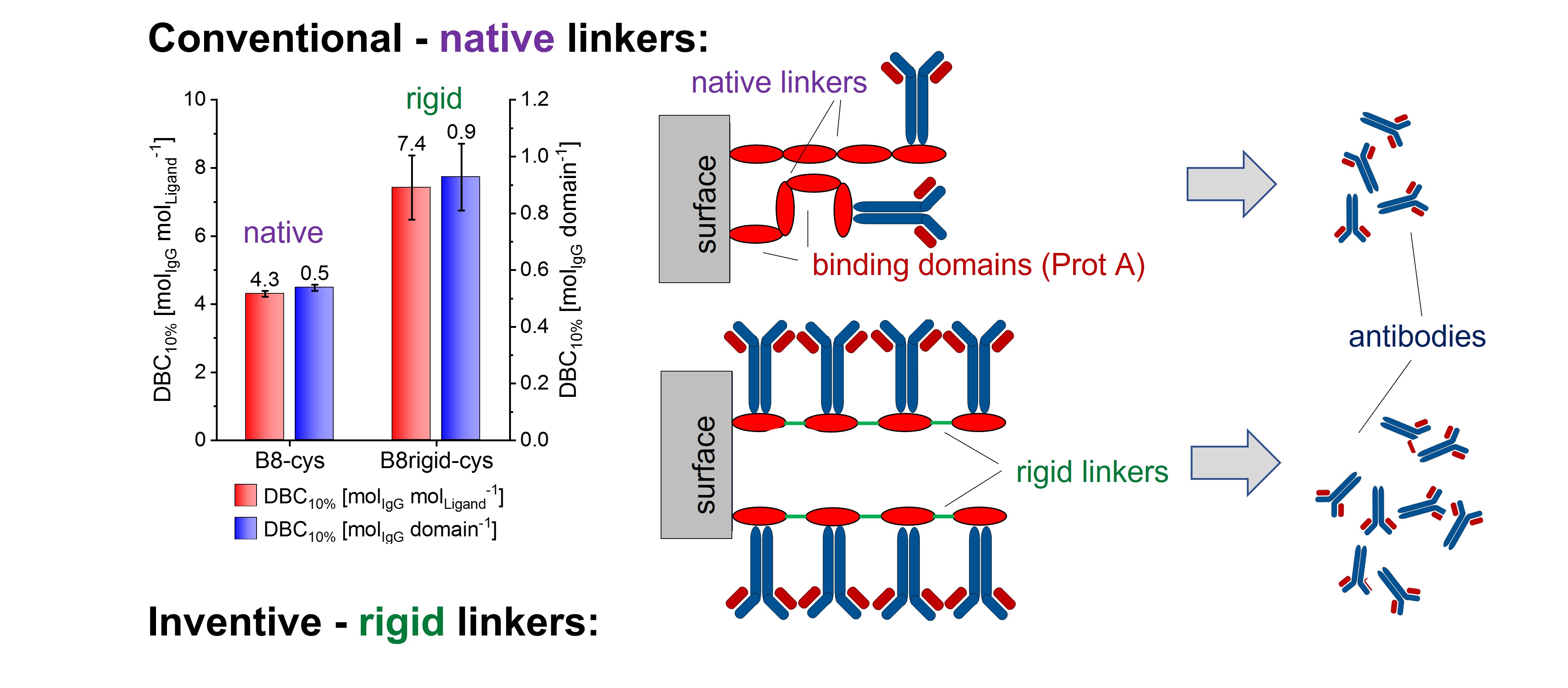
Affinity chromatography is industrially relevant. E.g. protein A resins are commonly used commercial antibody purifications. This step often becomes a bottleneck for manufacturing due to generally low binding capacities. One underestimated factor affecting binding capacity is that many binding sites of the immobilized Protein A ligand are not accessible to the relatively large antibodies. Since Protein A resin is expensive, increasing its binding capacity can directly lower antibody/mAb productions costs.
Our team of inventors from the Technical University of Munich have developed a new, rigid protein linker for affinity resins. It serves to ideally space out binding surfaces, which drastically increases e.g. antibody capture in antibody downstream processing. So far, a more than 50% increase in antibody capture per molar amount of Protein A could be achieved, as compared to a standard flexible linker. This directly translates into faster and cheaper industrial downstream processing. Our technology can easily be combined with other capacity-optimizing strategies such as domain multiplication or affinity-increasing point mutations.

Talk to an expert
Interested in learning more about this technology offer, exploring potential applications or discussing a possible collaboration? Get in touch to learn more.