
BICEP: A Bio-Inspired Compliant Elbow Prosthesis

Challenge and innovation
Commercially available elbow prostheses consist of a single rigid DoF rotational joint. These commercial systems can cover the physiologic range of motion (RoM), but their rigid and simplified design ends up strongly decreasing usability and robustness. In addition, these systems often adopt conventional rigid sockets to interface with the user, which often limits shoulder movements in the residual limb, e.g. external rotation.
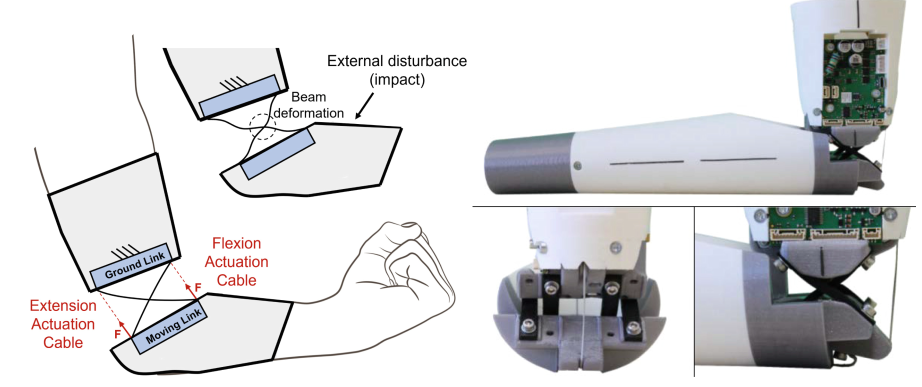
The actuation architecture of BICEP is inspired by the biological elbow joint structure and consists of 2 rigid prosthesis parts (corresponding to the upper and lower arm), which are connected by crossed flexible ligaments (Dyneema wires) intended to imitate the tendons. One replicates the bicep tendon and is used for flexion movements, while the extension movements are actuated by a tendon which replicates the tricep tendon. The two tendons system act as an agonist-antagonist mechanism, controlled by a motor which is widely used in robotic joint actuations.

Talk to an expert
Interested in learning more about this technology offer, exploring potential applications or discussing a possible collaboration? Get in touch to learn more.