
Carbon nanofiber electrodes for use in lateral flow assays

Challenge and innovation
In conventional LFAs, colorimetric detection by eye or camera only allows for semi-quantitative results. More advanced readout devices can measure reflectometrically or fluorescently but are very expensive. This defeats the purpose of a cheap test for a quick and easy use at home for consumers. There are currently no electrodes that can be integrated in a flow system and allow for electrochemical measurements in a 3D electrode network in conventionasl LFAs.
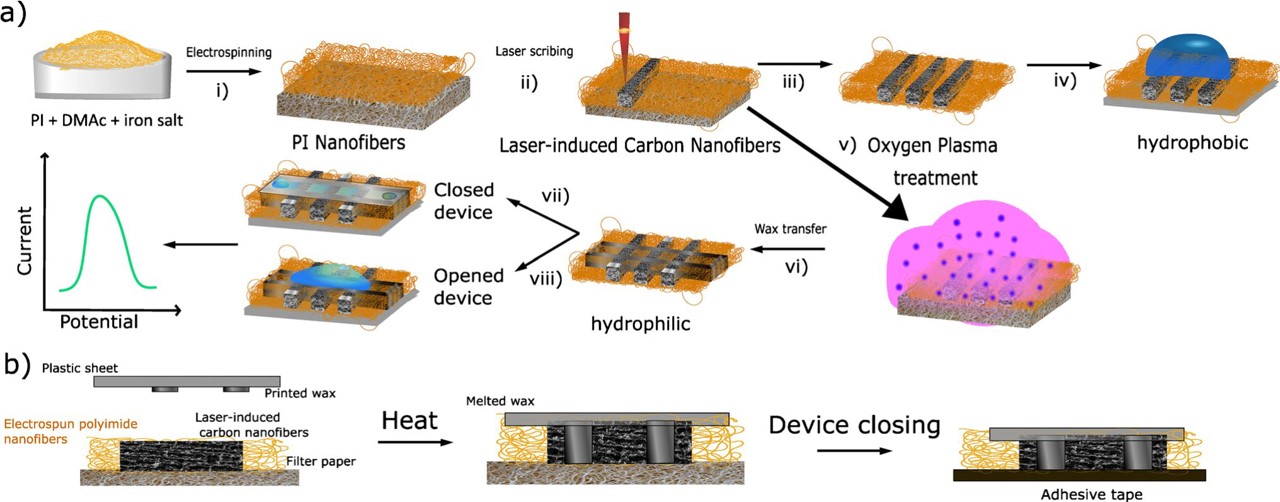
The invention describes printable freestanding laser-induced carbon nanofibers (LCNF) with outstanding analytical performance that can easily allow such miniaturization through a paper-based microfluidic strategy. 3D-carbon nanomaterials have proven to be high-performance transducers in electrochemical sensors. The LCNF electrodes were generated from electrospun polyimide nanofibers and one-step laser carbonization. Integration into closed microfluidic systems highlights that 3D porous structures provide excellent analytical performance and translation to affordable lab-on-a-chip devices such as LFAs.

Talk to an expert
Interested in learning more about this technology offer, exploring potential applications or discussing a possible collaboration? Get in touch to learn more.